Throughout Mental Health Month in May, The Texas Tribune is partnering with Mental Health Channel and KLRU to focus on some of Texas’ biggest challenges in providing mental health care. See all the stories in this series.
PLANO — On most mornings these days, Bari Greenwood’s 4-year-old daughter wakes up in her bunk bed, gets dressed by herself and eagerly waits to be taken to daycare.
For most 4-year-olds, these moments in a daily routine would hardly be worth mentioning. But Greenwood recounts them with the wide smile of a proud mother, for each is a hard-fought victory and a sign of remarkable progress.
Greenwood adopted her daughter in July 2015 but had cared for her for more than a year before that, when Child Protective Services removed the girl, then 2 years old, from her biological parents. Greenwood, a relative, agreed to take the infant in after adults in the home were found using methamphetamine, she said. There were also allegations the girl had been sexually assaulted.
It was a difficult transition for the child, traumatized first by her home situation and then again by her abrupt removal from it. Night terrors — bouts of shrieking and crying in the middle of the night — meant many sleepless nights for Greenwood and her husband, who would spend hours at the girl’s side, trying to console her.
There were other troubles. The child was terrified of taking baths, Greenwood said, and could not bear to be in rooms with a closet. She would not talk to men, and she often asked for her mattress to be placed on the floor because she was afraid to fall asleep in a bed.
She was standoffish and said very little, but she was “petrified” of being left alone, Greenwood said. Early on, when Greenwood would leave the child at daycare, “She cried and cried and gripped our legs, and she would always say, ‘Are you coming back?’”
At any given time, about 28,000 children are in the state’s care after being removed from abusive or neglectful homes. Like Greenwood’s daughter, those children often suffer from a combination of emotional and physical trauma. How to take care of them is a perennially vexing question for the state’s troubled foster care system.
One possible answer is an up-and-coming clinical model that aims to treat children’s emotional trauma as a medical condition. As lawmakers consider reforms to an embattled child welfare agency, state officials are pinning hopes on a handful of clinics around the state, aimed exclusively at foster children, where mental health services would be included at every point of a child’s medical treatment.
Read MoreMental Health Matters, Our Series on Mental Health Policy
Texas struggles to provide adequate mental health services to the children who need them, according to medical and social welfare experts. National research suggests up to 80 percent of foster children have at least one chronic medical condition, including trauma-related mental illness, but doctors often fail to treat those conditions in a timely way. Only about half of children in the state’s care receive a comprehensive health assessment within 30 days, state officials say, while health experts’ best practice guidelines suggest they should happen within three. A 2015 review of the Texas Department of Family and Protective Services found that severely needy children accessed behavioral health services at a surprisingly low rate, even when they were paid for by Medicaid, the public health insurance program that covers foster children.
Superior HealthPlan, the private insurer with the Texas Medicaid contract to cover foster children, is embarking on an experiment to help set up clinics where kids can get medical and mental health services at once, starting in Dallas, San Antonio, Houston and Lubbock. State officials hope the clinics, known as foster care centers of excellence, will better connect kids with trauma-informed behavioral health care.
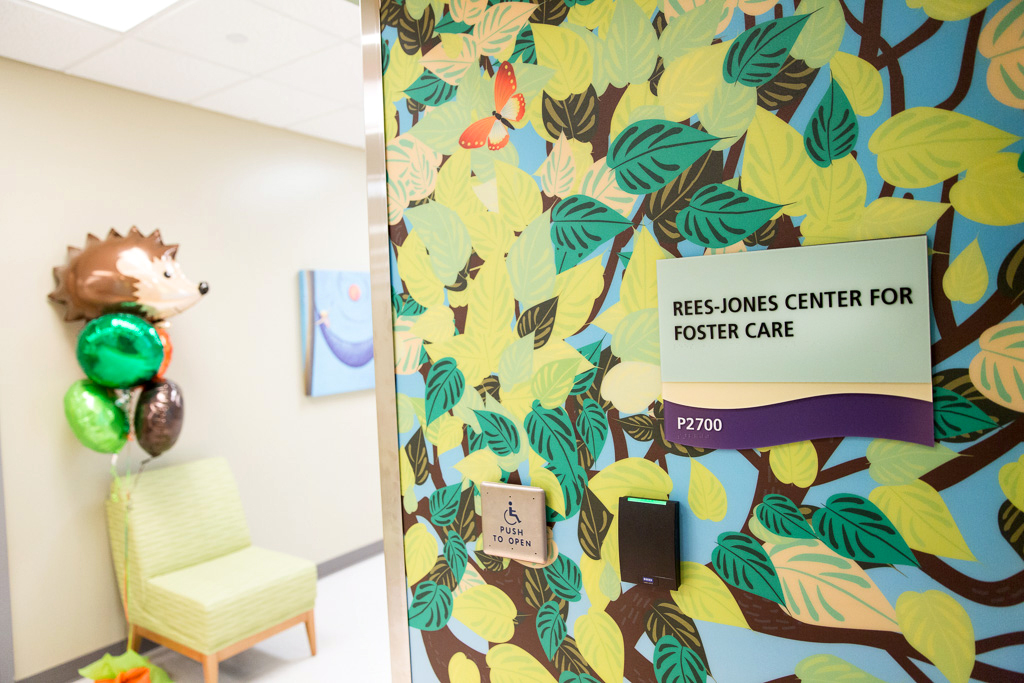
A model for those efforts is the Rees-Jones Center for Foster Care Excellence, housed in a wing of a children’s hospital in Plano. On a recent Wednesday afternoon, mental health care providers here described how they join doctors during children’s medical check-ups, asking about sleeping patterns and checking for symptoms of trauma. The clinic sees about 1,350 children in foster care each year.
In a soundproof room, a psychologist meets with a child’s caregiver while the child plays in the waiting room next door, visible through a glass window. The psychologist talks to the caregiver about the child’s behaviors and offers guidance about how to cope with the trauma symptoms that often come up: anxiety, jumpiness, sleep disorders, inability to concentrate.

This clinic is where Greenwood brought her daughter in the throes of their difficult transition. The child saw a psychologist, Greenwood said, and the whole family attended therapy sessions. There they learned to use dolls and role-playing techniques to help the girl talk about her anxieties.
Slowly, she got over her fears, and by now the night terrors are mostly gone, Greenwood said. (Greenwood is an employee of the hospital system that runs the Rees-Jones Center.)
“She has a bunk bed she picked out herself,” Greenwood said. “She loves daycare, she knows the whole alphabet and can write her name. She knows she can go in the pantry and refrigerator at any time.”
Doctors at the Rees-Jones Center say familiarity with a child’s trauma history — information the state typically has knowledge of — helps inform the health care services they provide. The clinic houses a Child Protective Services employee to serve as a liaison.
“Before those kids walk in the door, we know why they were removed, how many times they’ve been removed, how many times they’ve been transitioned,” said Laura Lamminen, a psychologist and the center’s behavioral health team lead.
“A lot of larger organizations don’t identify foster care as a special population in the way that they might a child with cerebral palsy or a child who has cancer,” she said.
But the center of excellence model specifically targets foster children. The low rates at which foster kids receive mental health care “may suggest that high-needs children have difficulty getting connected to the services they need,” wrote The Stephen Group, an outside consultant hired by the state to evaluate Texas’ child protection system. About one-eighth of the children in the state’s care, or nearly 6,000 children each year, were found to have high needs, including developmental disabilities or indicators of mental illness, such as depression or attachment disorders.
Every child in foster care is entitled to Medicaid coverage under a program known as STAR Health, which offers relatively generous benefits compared with other Texas public health care programs. Insurance companies have three to five times more Medicaid funding to spend on each child in foster care than they do for nondisabled children in other Medicaid groups, according to state health officials. But getting foster families to take advantage of behavioral health care remains an issue.
A specialized, team-based approach to treatment that includes mental health services is necessary, said Anu Partap, the Rees-Jones Center’s director, because abuse and neglect have tangible effects on a child’s health. Partap offered the analogy of a car crash. When a person is struck by a car, she said, there is a team-based approach to providing emergency care. If the person has a lung injury, there is a physician to attend to his breathing. If the person’s bones are shattered, a surgeon is brought in.
“It’s an assumption — a team needs to take care of what we know happens to you when you’re hit by a car,” she said. “That same mindset is what we need to use for our victims of abuse or neglect.”
Partap regularly testifies before the Texas Legislature to make recommendations on how the state could better provide health care to traumatized children. For one, she says, children need faster assessments. When they are first brought into care, she says, they should be seen by a team of medical professionals within three days.
Most of all, Partap thinks the state should make it easier for Child Protective Services caseworkers, mental health professionals and physical health care providers to talk to one another when taking care of an emotionally vulnerable population. She has asked state lawmakers to set aside funding to hire nurse coordinators, who would track children’s medical needs over their time in state conservatorship.

She also sees room for the state to improve the education and support it offers to the families who care for foster children. She recalled the story of a girl whose caregivers brought her to the clinic because she was ravenously eating and rapidly putting on weight.
“She’s been a victim, she’s been abandoned, she’s had grief, she’s had a death in her family, of a primary caregiver,” Partap said. “This is about her trauma. And I think what’s nice about this setting is we can talk about those things as a package.”
But many children in foster care lack access to mental health care services, which Partap said often leaves their root causes of illness untreated. “At a traditional clinic,” she said, “we’d just be like, ‘Oh, here’s a nutrition plan. Eat less. Run more. See you in a month.’”
Child welfare advocates echo many of Partap’s recommendations.
“Everyone who shapes a child’s life in foster care – including foster parents, front-line caseworkers, CPS officials, judges, doctors and even teachers – needs appropriate training to understand the impact of trauma on children’s development and behavior,” wrote Josette Saxton, director of mental health policy for the advocacy group Texans Care for Children, in an email.
“The Legislature and CPS have taken steps to make the state’s foster care system trauma-informed, but much more work needs to be done for these children,” she wrote.
State Sen. Charles Schwertner, R-Georgetown, told health care providers at an April hearing of the Senate Health and Human Services Committee, which he chairs, that he wanted better streamlining of services.
“We have all these various entities trying to help the children of Texas,” he said. “But we can’t seem to get it all together and get that child taken care of.”
Added Schwertner: “We seem to have all the pieces in the kitchen, but who’s the cook?”
Superior HealthPlan recently told state leaders it intends to build a network of foster care centers of excellence around the state.
“The goal of this initiative is to partner with health care clinics to offer children in foster care fully integrated, high quality behavioral and physical care through a trauma-informed approach,” said David Harmon, Superior’s chief medical director, in a statement. He said the health plan is in talks with clinics around the state to see if they meet criteria to become foster care centers of excellence.
Kim Cheung, a pediatrician at the University of Texas’ McGovern Medical School in Houston and the medical director of a Harris County foster care clinic, said hers was one clinic approached by Superior. Cheung said she is applying for a federal grant that would help the clinic meet those criteria.
Cheung said early results from her clinic’s integrated model were promising. The Harris County clinic in recent years brought in a child psychiatrist and a care manager to make it easier for kids to receive mental health services in addition to their medical and dental treatment.
“The children in foster care, they are all traumatized,” she said. “A lot of them need psychiatric evaluation and ongoing therapy, so the care manager and the psychiatrist have contributed really significantly to the mental health of these children.”
“A lot of larger organizations don’t identify foster care as a special population in the way that they might a child with cerebral palsy or a child who has cancer.”— Laura Lamminen, psychologist
Partap said she thinks the model of the Rees-Jones Center could be replicated all over the state.
Still, she concedes her center has many advantages that allowed it to get off the ground. The clinic is a project of Children’s Health, a large, nonprofit hospital system in North Texas. Through Children’s Health’s academic partnership with the University of Texas Southwestern Medical Center, the Rees-Jones Center has access to high-quality doctors, most of whom have faculty positions at the medical school.
The center also has tremendous charitable support. In 2013, the center received an $18.9 million donation from the Rees-Jones foundation, the philanthropic venture of Dallas billionaire Trevor Rees-Jones. At a recent open house for the Plano clinic, nonprofit executives hosted donors from that foundation and others to show off the center’s work and offer effusive thanks.
Partap said only about 20 percent of the center’s budget came from health insurance payments, mostly from Medicaid. The other 80 percent, she said, came from philanthropic donations or were paid for by Children’s or UT Southwestern.
Greenwood, the adoptive mother, said she learned about the Rees-Jones Center’s services through a colleague who also works for Children’s Health. But in her outside advocacy work, she said she regularly encounters families in the foster care system who have no idea about the mental health care that children are entitled to.
She said she wanted families to know how to take advantage of those services because she thinks it would help them be better caregivers. Her one message for those families: “Don’t ever give up on these kids.”
“Because those kids,” she said, her voice catching, “they don’t have a voice, and you’re here to take care of them.”
Disclosure: The University of Texas System and the University of Texas Southwestern Medical Center have been financial supporters of The Texas Tribune. A complete list of Tribune donors and sponsors can be viewed here.