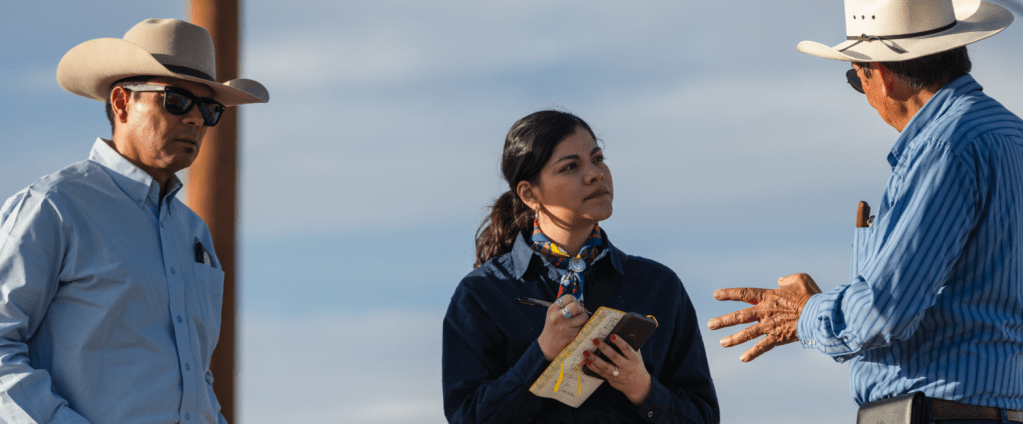
State Rep. Gina Hinojosa, the Democratic nominee for governor, is promising to send each Texas household a $1,500 check drawn from the state’s rainy day fund if she defeats Gov. Greg Abbott this November.
“The government is broken,” Hinojosa said Tuesday in front of Pyburn’s Farm Fresh Foods in Houston’s South Union neighborhood while announcing the proposal. “It is more, right now, a burden than a help for people. That changes when I’m governor.”
The $1,500 one-time rebate program — which Hinojosa dubbed a “corruption tax refund” — would cost the state $17 billion, her campaign estimated. It would be drawn from Texas’ rainy day fund — which is formally known as the Economic Stabilization Fund and serves essentially as a state savings account — which stood at a record $24.8 billion as of November 2025.
Hinojosa’s rebate proposal — which would require legislative approval — would draw down roughly two-thirds of the current account and leave around $10 billion in reserves. Her campaign pointed to estimates by the comptroller’s office that the fund will grow by roughly $2.5 billion to $3 billion a year, and historical trends that kept the account at around $10 billion for several years before swelling after 2022.
“It’s never been hoarded the way it currently is,” she said, adding, “We cannot find an economist who says it makes sense for us to be sitting on this money. It is irresponsible. This money should be in our economy in Texas.”
Hinojosa has embraced populist policy in her challenge to Abbott, whom she has accused of working on behalf of GOP megadonors at the expense of everyday Texans. Her policy rollout Tuesday kicked off a week of campaign stops around the state meant to illustrate how $1,500 checks could help working people.
Abbott, meanwhile, has made a sweeping property tax cut plan the centerpiece of his campaign for a fourth term. He has proposed ending school property taxes for homeowners, imposing tighter limits on how much property values can rise and making it harder for local governments to raise taxes even as their regions grow. And while he has largely ignored Hinojosa’s existence while on the campaign trail, he has railed against Democrats more broadly for opposing property tax cut measures he and other Republicans argued would improve affordability.
His campaign did not respond to a request for comment on Hinojosa’s proposal.
Recent public polling found Abbott leading Hinojosa by around 6 percentage points, while the U.S. Senate race at the top of the ticket between Democrat James Talarico and Republican Ken Paxton was tied. The incumbent governor remains a formidable opponent, with a staggering $96 million in his campaign coffers at the end of February compared to Hinojosa’s $617,000. Still, Texas Democrats are hopeful that a favorable political landscape fueled by discontent with the Trump administration, rising everyday costs and anti-incumbent sentiment can help them flip a statewide seat for the first time since 1994.
In announcing the proposal, Hinojosa charged Abbott with “hoarding” money in the rainy day fund and framed the idea as one that would give struggling Texans relief while maintaining necessary reserves in the state’s savings account. Her campaign said she would declare the “affordability crisis” an emergency item on the first day of her term, enabling state lawmakers to act on the rebate proposal as soon as the legislative session begins in January.
“There is one fight in this country, and the fight is this: Is this going to be a state that is by and for the people, or is this the billionaires’ world and we just live here?” Hinojosa said. “This helps to give Texans what they need right now to be able to afford to live and thrive in Texas.”
The Legislature created the rainy day fund in 1988 to help Texas weather fluctuating economic conditions. Largely funded by oil and gas tax revenues, the account has ballooned in recent years, with the Texas comptroller’s office projecting that it would exceed the cap on its balance and reach a record $28.5 billion by the end of fiscal year 2027.
The Texas Constitution limits the fund’s maximum balance using a formula based on how much general revenue was deposited into the account during the previous biennium. The fund is also subject to a statutory minimum balance of $12.4 billion for the 2026-27 biennium, according to the comptroller’s office.
State lawmakers have approved a total of $17.4 billion in spending out of the rainy day fund since its creation, according to the comptroller’s office. That spending has gone toward water infrastructure projects, natural disaster relief, public education and more. As the fund has grown, lawmakers have intensely debated how much of it to spend and how.
Rather than one-time investments in such programs, Hinojosa argued that her rebate proposal would be one of few policy ideas that a supermajority of lawmakers could get behind.
“We are paying into a system that is working against us, and I can’t think of anything else where we would all come together and have the votes to spend that kind of money to benefit real Texans,” she said. “I can’t imagine any politician voting against $1,500 to their constituents.”
Three-fifths of the state lawmakers must agree to draw from the rainy day fund in order to plug budget shortfalls, and two-thirds support is required to tap the fund for any other legislative purposes.